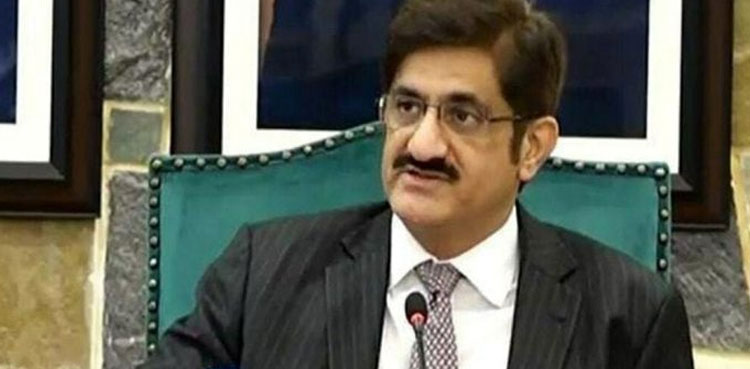
K-IV project planned to be completed in three phases: CM Sindh

K-IV project, CM Sindh, Murad Ali Shah, Karachi

KARACHI: Sindh Chief Minister (CM) Syed Murad Ali Shah on Friday asserted that Greater Karachi Water Supply Project known as K-IV was planned to be completed in three phases, vowing to overcome the shortage of metropolis, ARY News reported.

The chief minister made these remarks while speaking at the groundbreaking ceremony of the Greater Karachi Water Supply Project known as K-IV at CM House Karachi.

Murad Ali Shah noted that Karachi was receiving 600 Million Gallons of water per day against a demand of 1200 MGD which shows a shortfall of 600 MGD.

“With the fast-growing pace of urbanization in Karachi, this demand and supply gap would continue to grow, and offsetting of such demand would purely be dependent upon successful and timely completion of the K-IV project which is planned to be completed in three phases of total 650 MGD.”

The CM Sindh said that Karachi city has a demand of 1200 MGD water per day against which the Karachi Water & Sewerage Board is providing approximately 600 MGD from two sources combined Hub Dam and the Keenjhar Lake (Indus River) which means there is a shortfall of around 600 MGD.

Syed Murad Ali Shah said that the K-IV Phase-I with a capacity of 260 MGD was being executed by WAPDA and would be completed in 2025. He added that the Sindh government has taken responsibility to execute the K-IV augmentation project.

He added that the K-IV mainstream project could not become successful until Augmentation work was completed.

Murad Ali Shah said that the scope of the augmentation project started from the three reservoirs (R1, R2, and R3) built by WAPDA to the respective nodal points in the heart of the city.

CM Sindh added that all federal and provincial land-owning agencies have to play an active role in registering their ownership for the K-IV project.

He reiterated the commitment of his government to dovetail the augmentation project with the K-IV mainstream, for which the PC-I to the tune of Rs. 52 billion has already been submitted to the Ministry of Planning Government of Pakistan for seeking approval from CDWP and ECNEC.

Read More: Incomplete K-IV project causes Rs14b financial dent to exchequer

Murad Ali Shah said that the Sindh government was fully cognizant of the growing water demand and, therefore, has started exploring other sources of Water availability in Karachi.

“Projects are being conceived under Public Private Partnership for recycling wastewater to provide industrial-grade water to the Industrial Zones in Karachi,” he said and added that we were also determined to install Sea Water Reverse Osmosis (SWRO) Plants in Karachi on a pilot basis at two different locations.

He vowed to extend his full support to the federal government and WAPDA in the smooth execution of the K-IV Phase-I project (260 MGD) and after conducting the assessment for subsequent future phases.


from Latest Pakistan News Breaking News from All over Pakistan - ARY News https://ift.tt/qsuU5G3

Comments

Popular posts from this blog

BISE Malakand announces Matric Exam 2025 toppers

MALAKAND: The Board of Intermediate and Secondary Education (BISE) Malakand has formally declared the names of BISE Malakand Matric Toppers 2025 on Wednesday, July 30, 2025, lauding the students’ academic intellect across the region. According to the results, Malakand Board Toppers from both the Science and Humanities groups across the region secured the positions. This year’s BISE Malakand Matric toppers have proved an extraordinary performance in the Matric Annual Examination Part-I. Saman Wahab, a student from Hira School and College, Dargai, emerged as the winner in the list of BISE Malakand Matric Position holders by scoring an excellent 1169 in the science group. Huma Hameed, a student from Muhsanat Academy, Sangolai, achieved the top spot in the Humanities Group with 1094 marks. Science Group Toppers Name Institute Position Marks Saman Wahab Hira School and College Dargai, MKD 1st 1169 Komal Mehboob Qazi PIMS School and Girls College Biari, Dir (L) ...

President Zardari meets envoys of five countries, stresses global ties

ISLAMABAD: President Asif Ali Zardari highlighted the need to strengthen bilateral cooperation with Sri Lanka, Indonesia, Kyrgyzstan, Austria, and Germany as he greeted their recently appointed ambassadors at Aiwan-e-Sadr, ARY News reported. During the meeting, the appointed ambassadors formally presented their diplomatic credentials. Pakistan Armed Forces celebrated the ceremony with a guard of honour. In one-on-one meetings with the High Commissioner-designate of Sri Lanka and Ambassadors-designate of the other nations, President Asif Zardari stressed Pakistan’s commitment to strengthening bilateral cooperation in different sectors, including trade, economy, and culture. Asif Zardari expressed his best wishes to the diplomats on their new roles, hoping that their tenure would strengthen relationships and foster regional partnership. The ceremony was attended by the diplomats of different nations, including Rear-Admiral H.L.A. Don Fred Senevirante from Sri Lanka, Chandra Warsenan...

Pakistan floods: South Asia’s monsoon explained

Floods in Pakistan have killed more than 1,000 people after what its climate change minister called a record unbroken cycle of monsoon rains with “8 weeks of non-stop torrents”. AFP explains what the monsoon is, why it is so important and yet so dangerous, and how climate change and other man-made effects may be altering the vast life-giving but destructive annual weather system. What is the South Asian monsoon? The Southwest or the Asian Summer Monsoon is essentially a colossal sea breeze that brings South Asia 70-80 percent of its annual rainfall between June and September every year. It occurs when summer heat warms the landmass of the subcontinent, causing the air to rise and sucking in cooler Indian Ocean winds which then produce enormous volumes of rain. Why it is important? The monsoon is vital for agriculture and therefore for the livelihoods of millions of farmers and for food security in the poor region of around two billion people. But it brings destruction every ye...