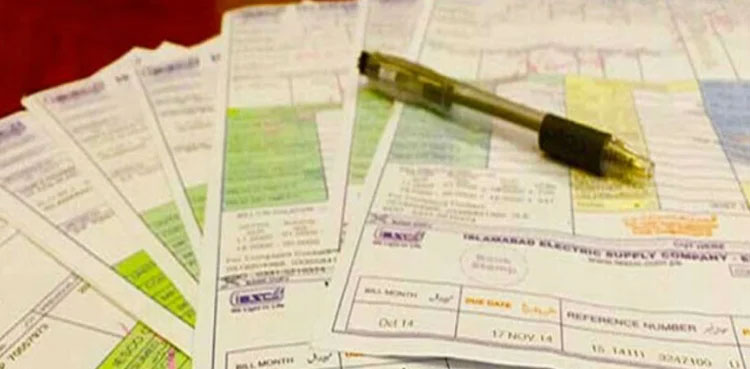
Here’s why masses are getting inflated electricity bills

electricity-bills-protest

KARACHI: Exorbitant bills have forced people to hit the streets across Pakistan. Here’s why the masses are getting inflated bills. 

Maria Memon, the host of the ARY News program “Sawal Yeh Hai,” while discussing the situation said that by carefully analyzing the electricity bills, every consumer can understand why they are being slapped with heavy bills?

She explained that the electricity bill she has in her hands is of a house that consumed 839 units in the month of August. In this bill, there are two types of charges applied, including the Islamabad Electric Supply Company and government charges.

The electricity charges in the bill are Rs35,842 for 839 units. In addition to this, due to fuel price adjustment, there is an FC surcharge of Rs2,709 and a QTR tariff adjustment of 1,447 rupees, bringing the total charges of this bill to 40,244 rupees.


View this post on Instagram


A post shared by ARY News (@arynewstv)

Furthermore, the government is imposing additional charges in this bill, including a TV fee of Rs35, GST of Rs7,128 in the TR tariff, Rs3,505 slapped on account of income tax charges, and another GST of 116 rupees. Alongside, an additional tax bill adjustment of Rs2,112 has also been included.

Read more: PPP announces countrywide protests against inflated electricity bills

Adding all these charges together, the government is charging Rs12,896 from this single bill. After these charges, the bill that was initially Rs35,842 has now become expanded to an amount of Rs53,241.


from Latest Pakistan News and Breaking News from All over Pakistan https://ift.tt/thR0EC7

Comments

Popular posts from this blog

BISE Malakand announces Matric Exam 2025 toppers

MALAKAND: The Board of Intermediate and Secondary Education (BISE) Malakand has formally declared the names of BISE Malakand Matric Toppers 2025 on Wednesday, July 30, 2025, lauding the students’ academic intellect across the region. According to the results, Malakand Board Toppers from both the Science and Humanities groups across the region secured the positions. This year’s BISE Malakand Matric toppers have proved an extraordinary performance in the Matric Annual Examination Part-I. Saman Wahab, a student from Hira School and College, Dargai, emerged as the winner in the list of BISE Malakand Matric Position holders by scoring an excellent 1169 in the science group. Huma Hameed, a student from Muhsanat Academy, Sangolai, achieved the top spot in the Humanities Group with 1094 marks. Science Group Toppers Name Institute Position Marks Saman Wahab Hira School and College Dargai, MKD 1st 1169 Komal Mehboob Qazi PIMS School and Girls College Biari, Dir (L) ...

President Zardari meets envoys of five countries, stresses global ties

ISLAMABAD: President Asif Ali Zardari highlighted the need to strengthen bilateral cooperation with Sri Lanka, Indonesia, Kyrgyzstan, Austria, and Germany as he greeted their recently appointed ambassadors at Aiwan-e-Sadr, ARY News reported. During the meeting, the appointed ambassadors formally presented their diplomatic credentials. Pakistan Armed Forces celebrated the ceremony with a guard of honour. In one-on-one meetings with the High Commissioner-designate of Sri Lanka and Ambassadors-designate of the other nations, President Asif Zardari stressed Pakistan’s commitment to strengthening bilateral cooperation in different sectors, including trade, economy, and culture. Asif Zardari expressed his best wishes to the diplomats on their new roles, hoping that their tenure would strengthen relationships and foster regional partnership. The ceremony was attended by the diplomats of different nations, including Rear-Admiral H.L.A. Don Fred Senevirante from Sri Lanka, Chandra Warsenan...

Pakistan floods: South Asia’s monsoon explained

Floods in Pakistan have killed more than 1,000 people after what its climate change minister called a record unbroken cycle of monsoon rains with “8 weeks of non-stop torrents”. AFP explains what the monsoon is, why it is so important and yet so dangerous, and how climate change and other man-made effects may be altering the vast life-giving but destructive annual weather system. What is the South Asian monsoon? The Southwest or the Asian Summer Monsoon is essentially a colossal sea breeze that brings South Asia 70-80 percent of its annual rainfall between June and September every year. It occurs when summer heat warms the landmass of the subcontinent, causing the air to rise and sucking in cooler Indian Ocean winds which then produce enormous volumes of rain. Why it is important? The monsoon is vital for agriculture and therefore for the livelihoods of millions of farmers and for food security in the poor region of around two billion people. But it brings destruction every ye...