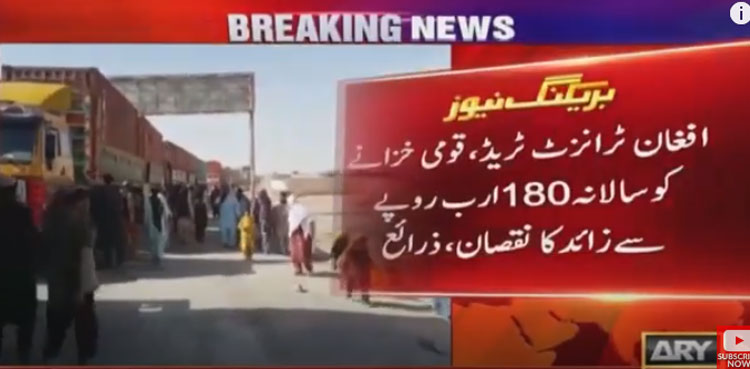
Pakistan prepares strategy to curb losses from Afghan transit trade

Afghan transit trade, FBR, smuggling

ISLAMABAD: Pakistan has formulated a new strategy to curb financial losses to the exchequer from the Afghan transit trade, citing sources, ARY News reported on Friday.

Sources told ARY News that Pakistan suffered an annual financial loss of Rs180 billion from the Afghan transit trade. To curb the financial losses, the Federal Board of Revenue (FBR) formulated a new strategy to stop smuggling of the transit commodities.

The documents mentioned that Pakistan would take 100% guarantee of all luxury items in the Afghan transit trade.

The federal government decided to end the smuggling of luxury items through the Afghan transit trade following the recommendations of the Special Investment Facilitations Council’s (SIFC) apex committee.

According to the documents, a ban was imposed on the exports of several luxury commodities including tyres, fabrics, cosmetics, tiles and other items until their clearance from the relevant authorities.

Related: Afghan Transit Trade key reason of black economy in Pakistan: report

It showed that the volume of the Pakistan-Afghanistan trade was soared to $6.71 billion from $2.5 billion within one year and it offset the impact of Pakistan’s import ban.

The documents also stated that the same commodities are being brought to the country through the transit trade after the imposition of ban or duties.

Several commodities were being sold in Pakistan after being smuggled from Afghanistan due to low duties.

It has been decided to conduct the revolving insurance and bank guarantees on all new consignments under the Afghan transit trade. The SIFC apex committee directed the FBR to impose 10% processing fees on the transit commodities from Afghanistan.

Sources added that Pakistan would spend the revenue from the Afghan transit trade’s processing fees on recovering the losses of infrastructure and road networks.

Earlier, it emerged that the Afghan Transit Trade left a negative impact over the national economy and has been one of the basic reasons of the black economy prevailing in Pakistan.

According to a report Afghan authorities misstate about prices of the Aghan Transit Trade items, which results in an obvious difference between the reported and real values of an item.

“These items brought back to Pakistan illegally for sale,” according to the report.

According to the Bureau of Statistics Afghan traders save three quarters of their trade items from customs duty by smuggling. “Thus, Pakistan sustain annual losses to the tune of around three billion dollars”.

“These traders tamper the tracking system installed on container trucks, which affect the tracking mechanism”.

These trucks used to sell the Afghan trade items on cheaper rates in black market in country, posing a threat to local industry.

Narcotics and other contraband items also used to smuggle with the transit trade. Fake bills of lading also causing complications in keeping the tracking record, sources said.


from Latest Pakistan News and Breaking News from All over Pakistan https://ift.tt/ZOSDI5R

Comments

Popular posts from this blog

BISE Malakand announces Matric Exam 2025 toppers

MALAKAND: The Board of Intermediate and Secondary Education (BISE) Malakand has formally declared the names of BISE Malakand Matric Toppers 2025 on Wednesday, July 30, 2025, lauding the students’ academic intellect across the region. According to the results, Malakand Board Toppers from both the Science and Humanities groups across the region secured the positions. This year’s BISE Malakand Matric toppers have proved an extraordinary performance in the Matric Annual Examination Part-I. Saman Wahab, a student from Hira School and College, Dargai, emerged as the winner in the list of BISE Malakand Matric Position holders by scoring an excellent 1169 in the science group. Huma Hameed, a student from Muhsanat Academy, Sangolai, achieved the top spot in the Humanities Group with 1094 marks. Science Group Toppers Name Institute Position Marks Saman Wahab Hira School and College Dargai, MKD 1st 1169 Komal Mehboob Qazi PIMS School and Girls College Biari, Dir (L) ...

President Zardari meets envoys of five countries, stresses global ties

ISLAMABAD: President Asif Ali Zardari highlighted the need to strengthen bilateral cooperation with Sri Lanka, Indonesia, Kyrgyzstan, Austria, and Germany as he greeted their recently appointed ambassadors at Aiwan-e-Sadr, ARY News reported. During the meeting, the appointed ambassadors formally presented their diplomatic credentials. Pakistan Armed Forces celebrated the ceremony with a guard of honour. In one-on-one meetings with the High Commissioner-designate of Sri Lanka and Ambassadors-designate of the other nations, President Asif Zardari stressed Pakistan’s commitment to strengthening bilateral cooperation in different sectors, including trade, economy, and culture. Asif Zardari expressed his best wishes to the diplomats on their new roles, hoping that their tenure would strengthen relationships and foster regional partnership. The ceremony was attended by the diplomats of different nations, including Rear-Admiral H.L.A. Don Fred Senevirante from Sri Lanka, Chandra Warsenan...

Pakistan floods: South Asia’s monsoon explained

Floods in Pakistan have killed more than 1,000 people after what its climate change minister called a record unbroken cycle of monsoon rains with “8 weeks of non-stop torrents”. AFP explains what the monsoon is, why it is so important and yet so dangerous, and how climate change and other man-made effects may be altering the vast life-giving but destructive annual weather system. What is the South Asian monsoon? The Southwest or the Asian Summer Monsoon is essentially a colossal sea breeze that brings South Asia 70-80 percent of its annual rainfall between June and September every year. It occurs when summer heat warms the landmass of the subcontinent, causing the air to rise and sucking in cooler Indian Ocean winds which then produce enormous volumes of rain. Why it is important? The monsoon is vital for agriculture and therefore for the livelihoods of millions of farmers and for food security in the poor region of around two billion people. But it brings destruction every ye...