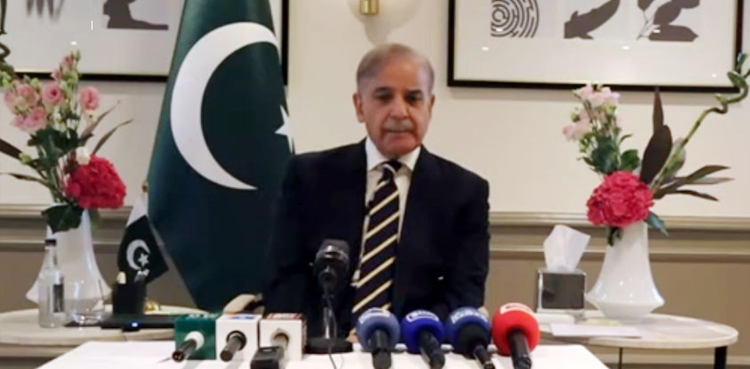
LONDON: Prime Minister (PM) Shehbaz Sharif once again invited all the political parties to sign the ‘Charter of Economy’ for the country, ARY News reported.
Addressing a presser in London, PM Shehbaz said that he expressed Pakistan’s position on a number of topics, including Palestine and Kashmir, to the international community in his address to the 79th United Nations General Assembly (UNGA)
The prime minister said he held meetings with different world leaders in New York on the sidelines of the UNGA.
PM Shehbaz Sharif said he held fruitful talks with world leaders including the British Prime Minister, the Chief Executive of Bangladesh, the President of Turkiye, the Prime Minister of Iraq, the Crown Prince of Kuwait, and others.
PM Shehbaz that said during his speech at the UNGA, he raised a forceful voice on Palestine issue saying that Palestine should be immediately given full membership in the United Nations.
“Pakistan condemns Israeli barbarism and atrocities being perpetrated in Gaza, and demanded immediate halt to bloodshed of the Palestinians,” he added
The prime minister said he also raised voice on the gross human rights violation and cruelties being carried out by Indian occupation forces on Indian illegally occupied Jammu and Kashmir.
He said the Kashmiris should be given their inalienable right to self-determination in accordance with the UN Security Council resolutions and holding Plebiscite as promised by the Kashmiris.
Turning towards economic situation of the country, the Prime Minister said it is heading towards stability and positive direction.
He said the government saved Pakistan from default and put economy back on right track. He said we signed a stand-by agreement with the International Monetary Fund and few days back, the IMF also approved seven billion dollars under Extended Fund Facility program for Pakistan.
The prime minister said he met with the MD IMF and President World Bank in New York, in which they lauded the economic development of Pakistan and the government measures in this connection.
The Prime Minister particularly thanked friendly countries Saudi Arabia, United Arab Emirates and China for playing a significant role and extending support to Pakistan in reaching agreement with the IMF.
He also thanked Finance Minister Muhammad Aurangzeb, Deputy Prime Minister and Foreign Minister Ishaq Dar and their economic team for their dedication and hard work. He also thanked Pakistan’s Ambassador to China and Chinese envoy to Pakistan for their role as well in approval of the IMF program.
PM Shehbaz Sharif also thanked Chief of Army Staff General Syed Asim Munir and lauded the role he played in reaching agreement with the IMF.
He said the country has come out from the economic slump, and now heading towards economic stability. He said inflation has dropped to 9.4 percent which was at 32 percent during the same period last year. The State Bank of Pakistan has cut policy rate which is now at 17 percent, while prices of commodities are also stable. He said all these indicators reflect that economic situation has improved a lot.
The Prime Minister stressed the need to make more collective efforts by the entire nation particularly the elite class for economic development of the country.
from Latest Pakistan News and Breaking News from All over Pakistan https://ift.tt/4U5ZPc8
Comments
Post a Comment