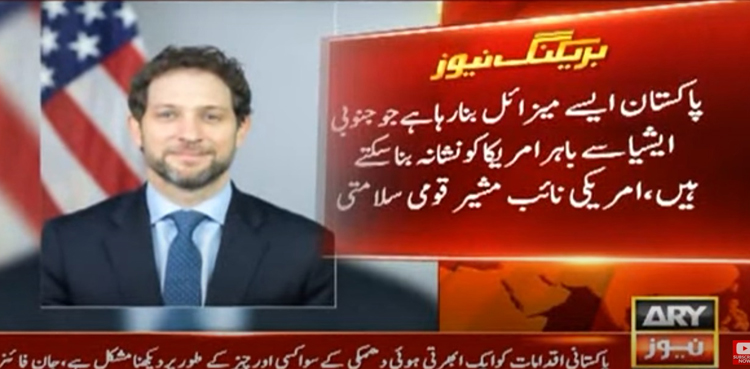
Pakistan developing missiles that could hit US, says top US official

Pakistan missile, program, US, ballistic missiles, asia

WASHINGTON: A senior White House official on Thursday said Pakistan is developing long-range ballistic missile capabilities that eventually could allow it to strike targets outside of South Asia, including in the United States.

Deputy National Security Advisor Jon Finer said Islamabad’s conduct raised “real questions” about the aims of its ballistic missile program.

“Candidly, it’s hard for us to see Pakistan’s actions as anything other than an emerging threat to the United States,” Finer told the Carnegie Endowment for International Peace audience.

“Pakistan has developed increasingly sophisticated missile technology, from long-range ballistic missile systems to equipment that would enable the testing of significantly larger rocket motors,” he said.

If those trends continue, Finer said, “Pakistan will have the capability to strike targets well beyond South Asia, including in the United States.”

His speech came a day after Washington announced a new round of sanctions related to Pakistan’s ballistic missile development program, including on the state-run defense agency that oversees the program.

A State Department factsheet said the Islamabad-based NDC has sought to obtain components for the country’s long-range ballistic missile program and missile-testing equipment.

The other entities slapped with sanctions were Affiliates International, Akhtar and Sons Private Limited and Rockside Enterprise, all located in Karachi, the factsheet said.

Meanwhile, Pakistan has termed the US decision to impose sanctions on NDC and three commercial entities as “unfortunate and biased” saying it defied the objective of peace and security.

Read more: Pakistan terms US sanctions on missile programme as ‘biased’

“Pakistan considers the US decision to impose sanctions on NDC and three commercial entities as unfortunate and biased,” according to a Foreign Office statement.

“Pakistan’s strategic capabilities are meant to defend its sovereignty and preserve peace and stability in South Asia. The latest installment of sanctions defies the objective of peace and security by aiming to accentuate military asymmetries. Such policies have dangerous implications for strategic stability of our region and beyond,” the Foreign Office statement said.


from Latest Pakistan News and Breaking News from All over Pakistan https://ift.tt/UrZ8Qj0

Comments

Popular posts from this blog

BISE Malakand announces Matric Exam 2025 toppers

MALAKAND: The Board of Intermediate and Secondary Education (BISE) Malakand has formally declared the names of BISE Malakand Matric Toppers 2025 on Wednesday, July 30, 2025, lauding the students’ academic intellect across the region. According to the results, Malakand Board Toppers from both the Science and Humanities groups across the region secured the positions. This year’s BISE Malakand Matric toppers have proved an extraordinary performance in the Matric Annual Examination Part-I. Saman Wahab, a student from Hira School and College, Dargai, emerged as the winner in the list of BISE Malakand Matric Position holders by scoring an excellent 1169 in the science group. Huma Hameed, a student from Muhsanat Academy, Sangolai, achieved the top spot in the Humanities Group with 1094 marks. Science Group Toppers Name Institute Position Marks Saman Wahab Hira School and College Dargai, MKD 1st 1169 Komal Mehboob Qazi PIMS School and Girls College Biari, Dir (L) ...

President Zardari meets envoys of five countries, stresses global ties

ISLAMABAD: President Asif Ali Zardari highlighted the need to strengthen bilateral cooperation with Sri Lanka, Indonesia, Kyrgyzstan, Austria, and Germany as he greeted their recently appointed ambassadors at Aiwan-e-Sadr, ARY News reported. During the meeting, the appointed ambassadors formally presented their diplomatic credentials. Pakistan Armed Forces celebrated the ceremony with a guard of honour. In one-on-one meetings with the High Commissioner-designate of Sri Lanka and Ambassadors-designate of the other nations, President Asif Zardari stressed Pakistan’s commitment to strengthening bilateral cooperation in different sectors, including trade, economy, and culture. Asif Zardari expressed his best wishes to the diplomats on their new roles, hoping that their tenure would strengthen relationships and foster regional partnership. The ceremony was attended by the diplomats of different nations, including Rear-Admiral H.L.A. Don Fred Senevirante from Sri Lanka, Chandra Warsenan...

Pakistan floods: South Asia’s monsoon explained

Floods in Pakistan have killed more than 1,000 people after what its climate change minister called a record unbroken cycle of monsoon rains with “8 weeks of non-stop torrents”. AFP explains what the monsoon is, why it is so important and yet so dangerous, and how climate change and other man-made effects may be altering the vast life-giving but destructive annual weather system. What is the South Asian monsoon? The Southwest or the Asian Summer Monsoon is essentially a colossal sea breeze that brings South Asia 70-80 percent of its annual rainfall between June and September every year. It occurs when summer heat warms the landmass of the subcontinent, causing the air to rise and sucking in cooler Indian Ocean winds which then produce enormous volumes of rain. Why it is important? The monsoon is vital for agriculture and therefore for the livelihoods of millions of farmers and for food security in the poor region of around two billion people. But it brings destruction every ye...