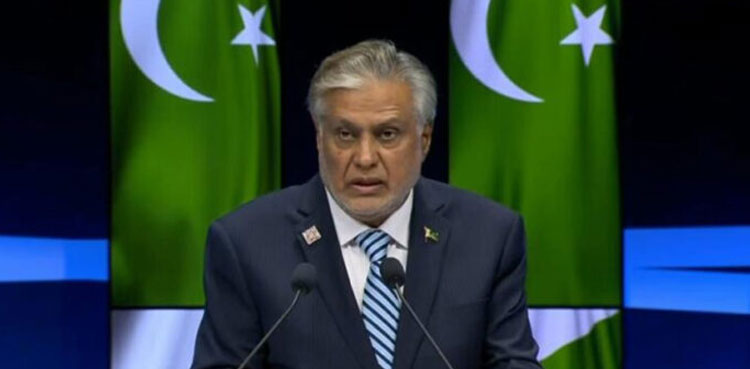
ISLAMABAD: Deputy Prime Minister and Foreign Minister Senator Ishaq Dar on Tuesday said that despite past setbacks, Pakistan’s economy is on the right path to achieving long-term growth.
Adressing an event titled “Opportunities for Economic Diplomacy to Promote Pakistan’s Trade and Investment” organised by Pakistan Business Council, the DPM highlighted the critical turning point of 2013, when the country was grappling with extreme load shedding, rampant terrorism, and a deteriorating economy on the brink of default.
“Our political party secured a third term to serve the country, and we introduced our three Es manifesto—Economy, Extremism, and Electricity—successfully addressing these issues,” he said. The results, he said, were clear as within three years, Pakistan became the 24th largest economy, saw record-high foreign reserves, and reduced inflation to below double digits.
Ishaq Dar said after 2018, the country faced a regression, with its economy slipping to 47th place and inflation climbing to double digits. The year 2022 brought another crisis, with economic bodies predicting a potential default but Pakistan has the ability to turn things around, he said, adding, “I believe Pakistan has the potential to streamline its reserves and recover.”
He recalled a pivotal moment in 2023 when the business community was disheartened by Pakistan’s external debt, which had surged to $130 billion. Yet, despite the challenges, Dar highlighted Pakistan’s natural wealth, including vast mineral reserves and hydrocarbons, which he believed would propel the country to its rightful position in the global economy.
“We are a nuclear and missile power, yet we lack continuity,” Ishaq Dar said and pointed to how Pakistan’s stability is often derailed during periods of progress. He also praised the efforts of the then PDM government for averting a potential default, adding that the country has since regained its standing on the international stage, citing Pakistan’s re-election to the UN Security Council with an overwhelming 182 votes.
Read More: IMF projects Pakistan economy to grow at 2.5pc in 2024
“Pakistan’s international diplomacy has seen a revival as well, with heads of state visiting the country and significant international cooperation in areas like education. Notably, the successful international conference on girls’ education, which saw the participation of 47 countries,” Ishaq Dar added.
The deputy prime minister also rejected misconceptions surrounding Pakistan’s economic viability, emphasizing that while the country faces a fiscal deficit in rupees, this can be managed. However, he acknowledged the critical need to address external debt, which remains a pressing challenge.
“The privatization of state-owned enterprises (SOEs) is another major aspect of the government’s strategy,” Dar said and revealed that 24 SOEs have been identified for privatization, alongside three international airports, which will have their services privatized. He urged Pakistan’s corporate sector to take the lead in these initiatives, including the potential privatization of Pakistan International Airlines (PIA).
“Pakistan’s business community has the capacity to manage large-scale transactions like the PIA takeover. We need Pakistani corporate groups to actively participate in the privatization of public enterprises,” Ishaq Dar said.
from Latest Pakistan News and Breaking News from All over Pakistan https://ift.tt/orjHYp6
Comments
Post a Comment