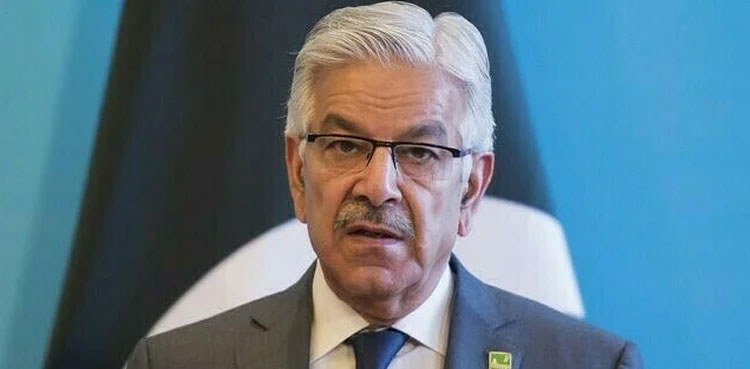
Pakistan warns India of befitting response to any misadventure

Pahalgam attack, Indus Waters Treaty , Pakistan India

ISLAMABAD: Pakistan has vowed befitting response to any misadventure by India under the garb of Pahalgam false flag operation in the Indian Illegally Occupied Jammu and Kashmir.

Defence Minister Khawaja Asif in a statement warned India of comprehensive response to any aggression, stating that Pakistan is always on high alert due to the hostile nature of its neighbour.

Khawaja Asif said that India has been trying to exit the Indus Waters Treaty for a long time, adding that Pakistan will not hesitate to respond if India takes any hostile action.

He made it clear that the Indus Waters Treaty, which has the World Bank as a guarantor, does not allow India to make unilateral decisions. He said that the treaty will be a top agenda item in the upcoming National Security Committee meeting.

“Pakistani nation unites when it comes to matters of national identity and that the country’s armed forces, including the Air Force, have full defensive capabilities,” the defence minister said

Khawaja Asif said that Pakistan desires normal relations with its neighbouring countries but at the same time is ready to respond strongly if provoked.

“We will respond to India’s adventures in the same way we did during the Abhinandan episode. If India makes any misadventure we will give a befitting response,” the defence minister said.

“Our armed forces, including the Air Force, have full defensive capabilities. We proved our strength four years ago and will do so again if needed.”

Khawaja Asif said that India is behind the militancy in Balochistan and Khyber Pakhtunkhwa, and that the world knows who is supporting terrorists in Pakistan.

“Pakistan has been the biggest victim of terrorism in the world,” Asif said. “Everyone knows who is behind the militancy in Balochistan and KP.”

Read More: India suspends Indus Waters Treaty, closes borders with Pakistan

Separately, Deputy Prime Minister and Foreign Minister Ishaq Dar termed the Indian mov as inappropriate and said that it will be given a befitting reply.

Ishaq Dar said that a meeting of the National Security Committee has been called. while Pakistan’s Foreign Ministry has already issued a statement on the Pahalgam attack.

The statements by top Pakistani officials came in response to India’s announcement to suspend the Indus Waters Treaty.

India’s foreign ministry on Wednesday announced that the Attari and Wagah borders will be closed. Pakistani nationals will no longer be able to travel to India under the SAARC visa exemption.

“The Indus Waters Treaty of 1960 will be held in abeyance with immediate effect,” India’s top diplomat Vikram Misri told media persons in New Delhi.

The Indian foreign ministry also announced to India recall all its defense attachés from Islamabad.

The Indian foreign ministry maintained that the number of diplomatic staff will be reduced from 55 to 30, asking the military advisors in the Pakistani High Commission in New Delhi to leave the country within a week.

India is further reducing diplomatic relations with Pakistan, as the ties were reduced to consular instead of high commissioner back in 2019.


from Latest Pakistan News and Breaking News from All over Pakistan https://ift.tt/NzWBEHS

Comments

Popular posts from this blog

BISE Malakand announces Matric Exam 2025 toppers

MALAKAND: The Board of Intermediate and Secondary Education (BISE) Malakand has formally declared the names of BISE Malakand Matric Toppers 2025 on Wednesday, July 30, 2025, lauding the students’ academic intellect across the region. According to the results, Malakand Board Toppers from both the Science and Humanities groups across the region secured the positions. This year’s BISE Malakand Matric toppers have proved an extraordinary performance in the Matric Annual Examination Part-I. Saman Wahab, a student from Hira School and College, Dargai, emerged as the winner in the list of BISE Malakand Matric Position holders by scoring an excellent 1169 in the science group. Huma Hameed, a student from Muhsanat Academy, Sangolai, achieved the top spot in the Humanities Group with 1094 marks. Science Group Toppers Name Institute Position Marks Saman Wahab Hira School and College Dargai, MKD 1st 1169 Komal Mehboob Qazi PIMS School and Girls College Biari, Dir (L) ...

President Zardari meets envoys of five countries, stresses global ties

ISLAMABAD: President Asif Ali Zardari highlighted the need to strengthen bilateral cooperation with Sri Lanka, Indonesia, Kyrgyzstan, Austria, and Germany as he greeted their recently appointed ambassadors at Aiwan-e-Sadr, ARY News reported. During the meeting, the appointed ambassadors formally presented their diplomatic credentials. Pakistan Armed Forces celebrated the ceremony with a guard of honour. In one-on-one meetings with the High Commissioner-designate of Sri Lanka and Ambassadors-designate of the other nations, President Asif Zardari stressed Pakistan’s commitment to strengthening bilateral cooperation in different sectors, including trade, economy, and culture. Asif Zardari expressed his best wishes to the diplomats on their new roles, hoping that their tenure would strengthen relationships and foster regional partnership. The ceremony was attended by the diplomats of different nations, including Rear-Admiral H.L.A. Don Fred Senevirante from Sri Lanka, Chandra Warsenan...

Pakistan floods: South Asia’s monsoon explained

Floods in Pakistan have killed more than 1,000 people after what its climate change minister called a record unbroken cycle of monsoon rains with “8 weeks of non-stop torrents”. AFP explains what the monsoon is, why it is so important and yet so dangerous, and how climate change and other man-made effects may be altering the vast life-giving but destructive annual weather system. What is the South Asian monsoon? The Southwest or the Asian Summer Monsoon is essentially a colossal sea breeze that brings South Asia 70-80 percent of its annual rainfall between June and September every year. It occurs when summer heat warms the landmass of the subcontinent, causing the air to rise and sucking in cooler Indian Ocean winds which then produce enormous volumes of rain. Why it is important? The monsoon is vital for agriculture and therefore for the livelihoods of millions of farmers and for food security in the poor region of around two billion people. But it brings destruction every ye...